HueArts & Cultures: Northeast
Part of an ambitious national expansion of Museum Hue’s research, our latest map and directory includes arts and cultural entities of color in Northeastern states.

HueArts & Cultures: Northeast
A Gathering Ground Filled with Hue
About
Museum Hue’s mission is to support Black, Indigenous, Latino/e/x, Asian, Middle Eastern, and all People of Color in the arts and culture field through advocacy, elevated visibility, and community engagement.
HueArts & Cultures Northeast is an expansion of Museum Hue’s HueArts New York City and HueArts New York State, seeking to connect and amplify cultural entities created and led by Black, Indigenous, Latino/e/x, Asian, Middle Eastern, and all Cultural Workers of Color through an online database that encompasses the history, geographic location, and significance of these organizations. Museum Hue is currently focusing on the Northeastern region of the United States, and its long-term goal is a full scale national platform that serves these museums and cultural centers, as well as their stakeholders (current and future).
Museum Hue engaged Yancey Consulting and Slover Linett at NORC to connect with these Hue museums and cultural centers in the Northeast to hear their stories and insights and gather their data to guide the design of Museum Hue’s digital platform.
Acknowledgements
This project was made possible in part by the Institute of Museum and Library Services, the National Endowment for the Arts and by the Mellon Foundation.



Foreword
Meeting with Dr. Lonnie G. Bunch III, Secretary of the Smithsonian Institution
Stephanie Johnson-Cunningham
Co-Founder & Executive Director, Museum Hue
I had the opportunity to meet with Dr. Lonnie G. Bunch III, Secretary of the Smithsonian Institution to discuss Museum Hue’s HueArts & Cultures research initiative during the early stages of this report in 2024. It was incredibly important to me to gather his insights, as he has contributed profoundly to the museum field long before stepping into his current role.
My first introduction to Dr. Bunch’s work came during my undergraduate studies when I read his article “Flies in the Buttermilk.” The title refers to someone who is out of place in a historically predominantly white environment, which felt especially resonant within the context of U.S. museums. Published in 2000, “Flies in the Buttermilk: Museums, Diversity, and the Will to Change” challenged the field to confront its lack of diversity in staffing. Even encountering the article nearly ten years after it was written, it remained strikingly relevant to my own early experience as I was entering the museum profession.
From that moment on, Dr. Bunch stayed on my radar. When I later learned that he would lead the efforts to open the Smithsonian’s National Museum of African American History and Culture, I was deeply inspired. Over the years, I have had the privilege of meeting him in passing at American Alliance of Museums conferences. Even in brief exchanges, I valued his reflections and the clarity with which he articulated the work ahead for the field.
For these reasons and many more, it is my honor to have Secretary Bunch provide a Foreword for the HueArts & Cultures: Northeast report.
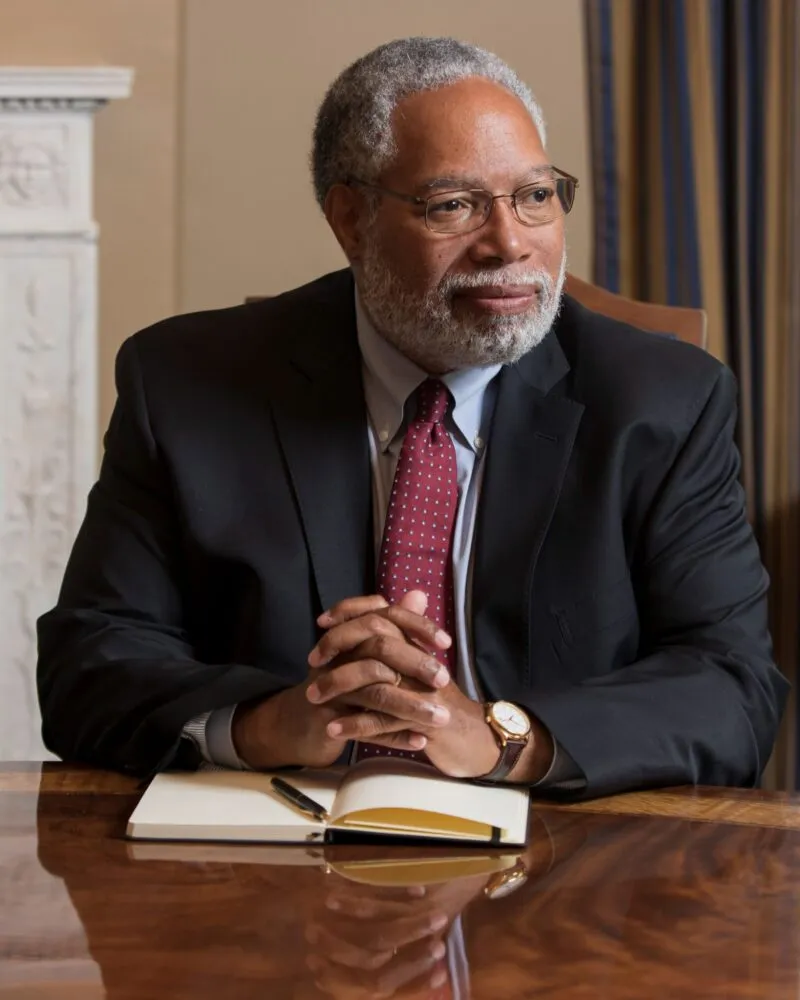
Dr. Lonnie G. Bunch III, Secretary of the Smithsonian Institution
Foreword: A Reservoir for Museum Professionals
Dr. Lonnie G. Bunch III
Secretary of the Smithsonian Institution
Museum Hue’s research initiative documenting the contributions and challenges of leaders at cultural institutions founded and led by Black, Indigenous, Latino/e/x, Asian, Middle Eastern, and all People of Color across the United States is, quite simply, essential. I believe that their research has been framed in a brilliant way and this report offers vital insights into the trailblazers who, throughout history and today, often work as both activists and museum professionals.
What excites me about Museum Hue’s research is the opportunity to address a major gap in our field: that there’s a need for more critical literature about African American museums and all other museums of color. There is a striking lack of data, scholarship, and thought leadership of the groundbreaking work these institutions have already done. When I wrote a book about building a museum, it was because there were no guides or literature that explained how to do it. In museums, the only permanent things are what you collect and the documentation you produce. Books and articles endure. Encouraging both is essential if these institutions are to continue changing the nation. And they are changing the nation. Their work remains a reservoir from which they, and the field at large, can draw strength to continue the fight.
Outside of the collections the only documentation that’s permanent are the books and articles we ourselves write. Too many arts leaders find themselves reinventing the wheel over and over again, rather than drawing from established best practices. Many museums of color are doing transformative work, yet there is not enough accessible information for arts professionals to learn from their innovations to shape their own practice accordingly. Publications centering these institutions have the potential to be transformative, helping institutionalize their histories and elevate their contributions.
"What excites me about Museum Hue’s research is the opportunity to address a major gap in our field: that there’s a need for more critical literature about African American museums and all other museums of color."
The fact is, institutions of color have changed the museum profession and transformed it in a way that many don’t know. They led the way in emphasizing education, insisting that part of any museum’s role is an educational vision. They championed the collecting of art and objects and “stuff” that nobody else cared about for years. These are not minor and modest institutions, they are groundbreaking because they answered the fundamental call that, if museums can’t be community centers, then they sure should be at the center of their community.
Part of our work is helping institutions recognize just how profoundly their history has shaped this profession and to remember that by the work they do they are changing a nation. The power of museums of color lies in the lenses they provide into creativity, history, and cultural expression. And they are absolutely necessary not only to their communities but to the entire United States.
Museum Hue’s unique ability to illuminate the reservoirs of knowledge that already exist is urgently needed. Their effort to craft centralized data around the intersectionality of these institutions—data that bridges geographic, cultural, thematic, and historical lines—will provide tools that the entire field can use. This research report offers the possibility for deep learning precisely because it connects institutions of color multidimensionally.
The HueArts & Cultures research is especially vital because of the world we’re in today. Given the attacks on DEI, the attacks on the importance of culture, the importance of history. Not to mention the simplistic notion that the culture of one doesn’t affect the culture of others. Within this context, Museum Hue’s work could not be more important. I am thrilled to support this initiative and look forward to the profound impact of this research on this field as well as on the next generation of museum leaders carrying the mantle forward to advance our sector.
Opening Letter
Stephanie Johnson-Cunningham
Co-Founder & Executive Director, Museum Hue
Inspired by the immense contributions and the ongoing perseverance of leaders at the helm of African American museums and culturally specific institutions of color I have encountered throughout my career, it is my pleasure to invite you to deep dive into Museum Hue’s latest research initiative, HueArts & Cultures: Northeast. This report investigates the unique histories, experiences, pedagogies, and practices of museums and cultural centers founded and led by Black, Indigenous, Latino/e/x, Asian, Middle Eastern, and all People of Color across 11 northern states and one district.
The HueArts & Cultures: Northeast initiative is deeply personal for me. Throughout my career I have had the privilege of working at several of the institutions which are highlighted in this research. I know firsthand how crucial their impact has been on the museum field. They have also been foundational to my own professional development and to my understanding of what it truly means to steward culture with care, integrity, and accountability to community.
From internships to leadership roles, my professional journey has been profoundly shaped by these organizations and their leadership. I interned at Weeksville Heritage Center, the multidisciplinary museum and historic Brooklyn site, and later returned again to assist with their community outreach. As a volunteer docent at the Studio Museum in Harlem, I immersed myself in the history and collections of this crucial nexus for artists of African descent, and sharpened my skills as an educator leading tours and workshops. My career growth deepened during the Innovative Cultural Advocacy (ICA) fellowship at the Caribbean Cultural Center African Diaspora Institute (CCCADI), where I met with visionary museum leaders from the Museum of Chinese in America and El Museo del Barrio, among others. Subsequently, as Curator of Education at the African American Museum in Philadelphia (AAMP), I focused on advancing educational programs and interpretive materials.
"Throughout my career I have had the privilege of working at several of the institutions which are highlighted in this research. I know firsthand how crucial their impact has been on the museum field."
Today, leaders from TCGM (Vashti DuBois), CCCADI (Melody Capote), and my former supervisor from AAMP (Ivan Henderson) now serve on the HueArts & Cultures advisory committee.
These institutions, founded between the 1960s and 1980s–an era shaped profoundly by the Civil Rights Movement–are essential sites that tirelessly push against exclusion to tell full, unvarnished American stories. In fact, it was the guidance and experiences from these leaders and cultural anchors that were instrumental in the founding of Museum Hue in 2015. Our early efforts were encouraged by leaders at CCCADI, while our one year anniversary celebration was hosted at the Studio Museum in Harlem. This legacy of collaboration continues, as evidenced by the launch of our first symposium, The Legacy of Black Communities Built and Sustained, at Weeksville Heritage Center in 2024.
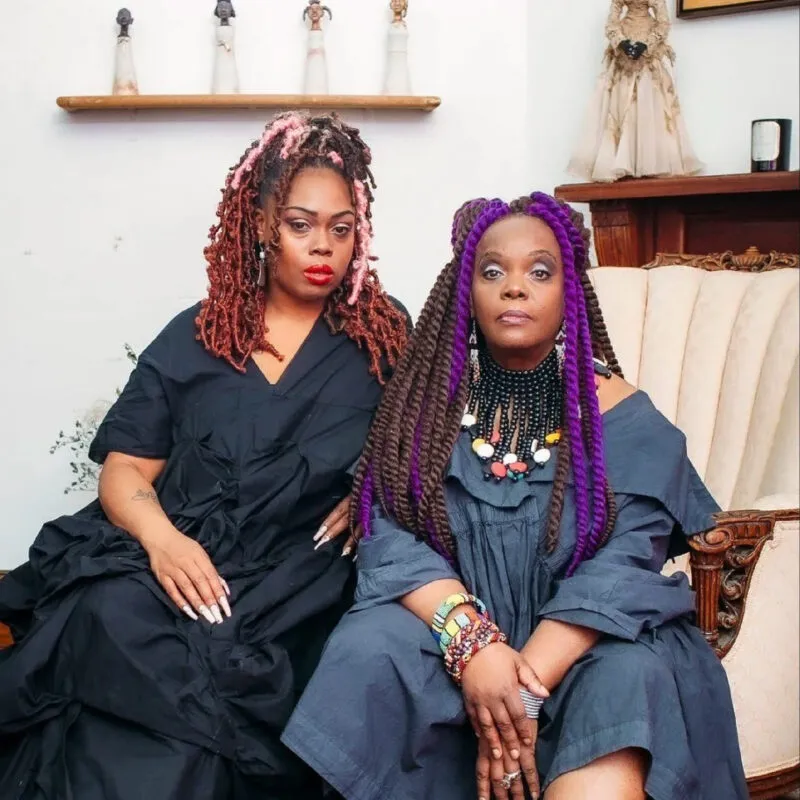
I have also been inspired by cultural institutions formed in more recent years such as The Colored Girls Museum (TCGM), which center and champion the “ordinary” Colored girl of African descent. Founded in 2015 by Vashti DuBois, who also serves as Executive Director, TCGM is housed in her home—a 140-year-old, three-story Victorian Twin House in historic Germantown, Philadelphia. She designed the museum as a sanctuary, a place for reflecting on and lifting up Black girls and women in order to honor, preserve, and present our ordinary and extraordinary stories through visual artwork and site specific installations. On the wall, a quote from DuBois reads that the museum is “for anyone who is ready for a conscious revolution.” Visitors are guided through the joyful life and sometimes sorrowful existence of the Black girl, and it offers antidotal actions for restoration. It is a gift to the Colored girl—and to the world.
This study expands the canon of Hue thought leadership by offering comparative and intersectional data across Museum Hue’s combined studies, while proposing concrete strategies for greater connectivity. Cumulatively, this research underscores that museums and cultural centers founded and led by Black, Indigenous, Latino/e/x, Asian, Middle Eastern, and all People of Color share histories, celebrate artistic practices, strengthen cultural ties, and improve the conditions of communities—and have been essential to collective liberation.
These organizations are indelible and trusted sites, created to provide consistent and authentic platforms for cultural representation—often in direct response to racial inequities and a need to broaden public understanding through art, history, and culture. Many institutions leveraged best practices in collections care, scholarship, and operations to gain legitimacy. Others built new models in opposition to traditional, colonial museum practices. Many have long argued for recognition of their own cultural authority.
Their community-centered practices often emphasize relationship, placekeeping, and accountability over a collection-centered approach. They engage communities through innovative models while aligning their racial justice missions with their roles as advocates, historical stewards, and cultural anchors. They offer presentations of living legacies and creative lifeways. Institution-building itself has been a vital form of agency—creating opportunities to tell stories on their own terms while shaping more authentic forms of interpretation, memory work, identity development, connectivity, and trust.
"This study expands the canon of Hue thought leadership by offering comparative and intersectional data across Museum Hue’s combined studies, while proposing concrete strategies for greater connectivity."
Our long-term goal is a full-scale national platform. The phase presented here focuses on the Northeast region of the United States, building on HueArts NYC—highlighting over 400 arts entities across New York City’s five boroughs—and HueArts NYS, which features close to 150 additional arts entities across New York State outside of NYC, including a digital map, directory, and report. HueArts covers all 10 of New York’s vast and distinct regions. The HueArts & Cultures multi-state approach differs from previous projects because the territories, governance, and landscapes across the Northeast hold their own histories, creative lifeways, and opportunities. While widely differing, these institutions are united in their commitment to advocacy, representation in the field, and racial equity in society at large.
To complete the first stage of our national research, Museum Hue was awarded one of the most competitive federal opportunities in our field: an Institute of Museum and Library Services (IMLS) National Leadership Grant. Midway through the project, amid efforts to decimate IMLS, that funding was terminated at approximately halfway through our work. Thankfully, the termination was later overturned due to a temporary—now permanent—injunction that remains under appeal.
While restored as of this writing, the insecure status of such a major multi-year grant is highly distressing, demoralizing, and distracting to Museum Hue and other recipients of federal support. One of the core findings of HueArts & Cultures: Northeast is how profoundly funding shapes our field—who gets to survive, and who is expected to fight for every penny. The irony is not lost on us: the very research we conducted—about the challenges, vulnerabilities, and systemic underfunding of culturally specific institutions—was interrupted by the same forces we have been naming and working to change. This moment is difficult, but it strengthens our resolve. Museum Hue’s work, and the work of HueArts & Cultures, will continue as we regroup, reimagine, and redouble our commitment to one another. We are diversifying our funding, building new partnerships, and staying rooted in the belief that our stories, our research, our leadership, and our cultural legacies matter.
We are still here. And we are resolved to remain steadfast in our work.
As we continue our national research, we look forward to learning how each region’s histories, cultures, and identities shape the circumstances of these institutions. We hope you will give careful attention to the stories and data presented here—and in the accompanying digital map and directory on Museum Hue’s website—so that together we can better understand the circumstances, histories, and contributions of museums and cultural centers founded and led by Black, Indigenous, Latino/e/x, Asian, Middle Eastern, and all People of Color in the Northeast region of the United States. As plans unfold for the nation’s 250th anniversary, or Semiquincentennial, remember that the contributions and confrontations of all communities across the United States of America have paved the way.
With gratitude and resolve,
Stephanie Johnson-Cunningham
Co-Founder & Executive Director, Museum Hue
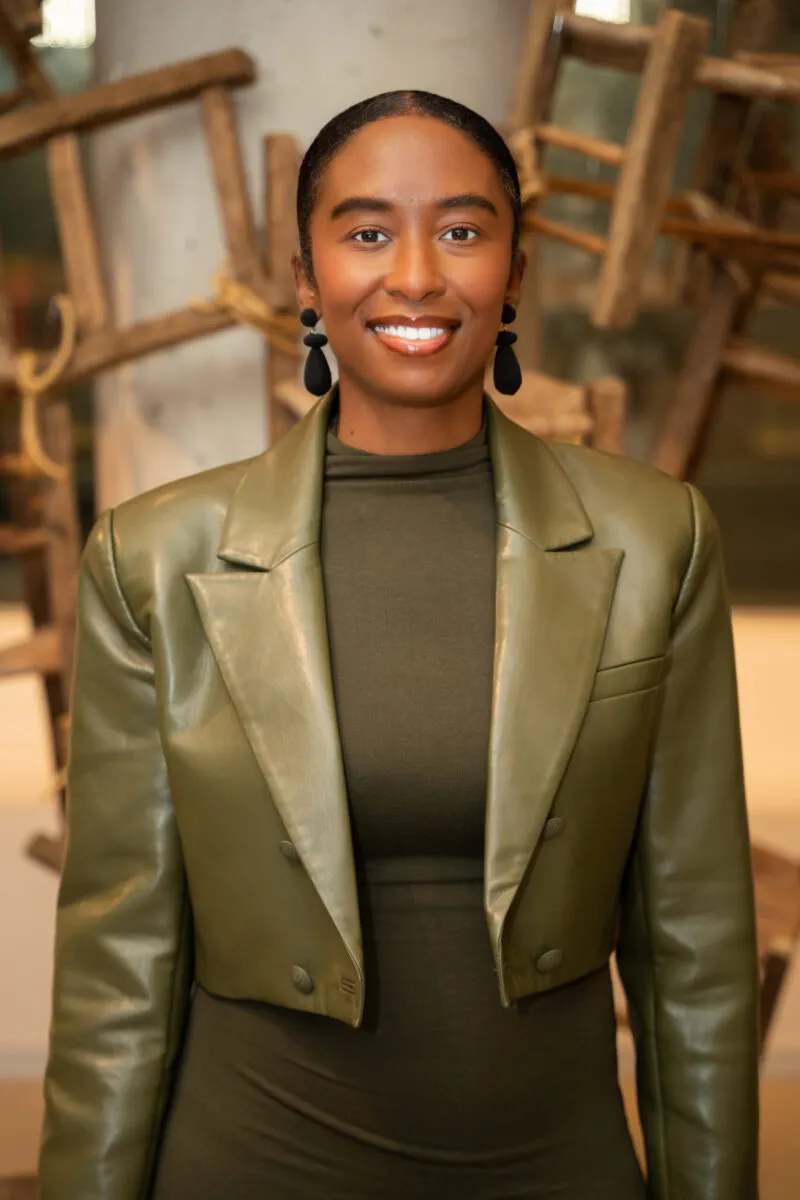
Stephanie Johnson-Cunningham, Co-Founder & Executive Director, Museum Hue
Executive Summary
At the outset, we would like to note some key language and terminology used in this report. We use the term Hue Cultures to refer to the intergenerational, multi ethnic, multi-racial, and cross-regional palette of histories, offerings, motivations, beliefs, values, customs, rituals, foresight, stories, and approaches. When we refer to the people administrating and governing these museums and cultural centers, we call them Hue Custodians. Hue Communities are the individuals, neighborhoods, and environments Hue Custodians serve. Hue is color in all its gradations and varieties. We aim to reference a palette with many variations across the spectrum. We do not conflate, meld, or presume that one Black story is all Black stories or that one Indigenous custom reflects all Indigenous customs. We can hold space for shared values and overlapping needs with nuanced reservations and place-specific caveats.
We also regularly name Black, Indigenous, Latino/e/x, Asian, Middle Eastern, and all People of Color whenever possible. We understand there is much diversity within these groups, and each group’s historical and current experience with racial and ethnic inequality is unique. Additionally, although we are acutely aware that the terms People of Color (POC) and Black, Indigenous, and People of Color (BIPOC) can be problematic, we may sometimes use them as unifiers, for brevity, or when quoting Hue Custodians who use the terms.
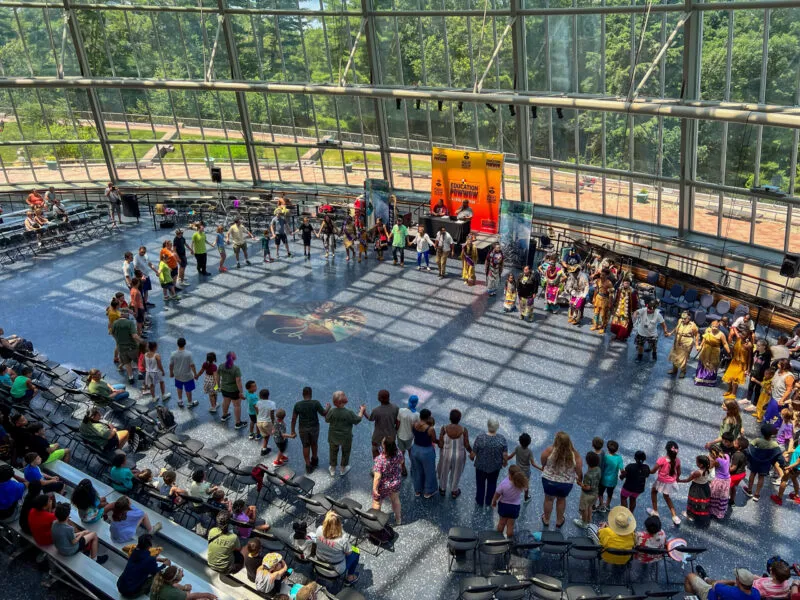
Mashantucket Pequot Museum & Research Center
Project Overview and Study Approach
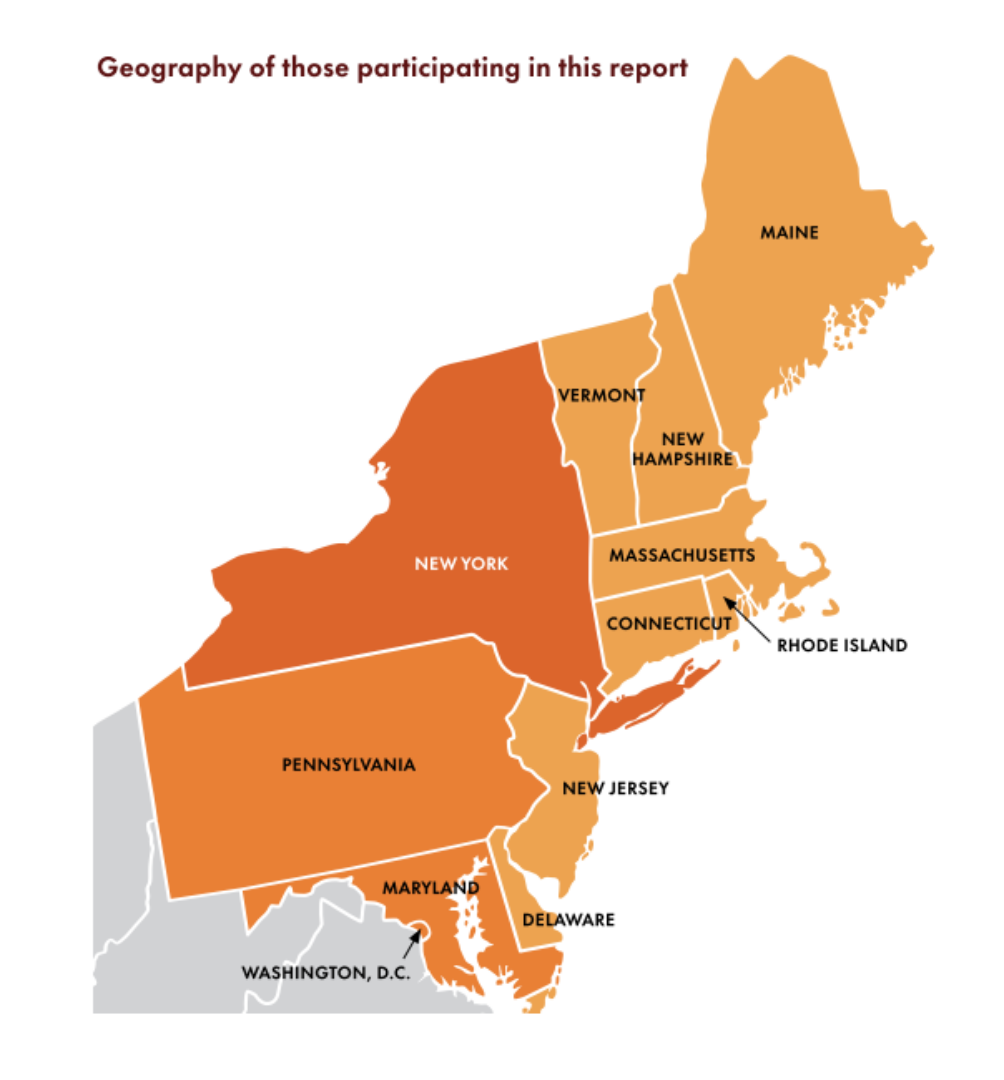
Museum Hue, Yancey Consulting (YC), and Slover Linett at NORC came together for the Northeast United States portion of Museum Hue’s HueArts & Cultures project and initiative to develop a digital platform that includes a map, directory, and report. The goal was to better understand museums and cultural centers in the region that are founded and led by Black, Indigenous, Latino/e/x, Asian, Middle Eastern, and all People of Color, focusing on 11 states and one district: Connecticut, Delaware, Maine, Maryland, Massachusetts, New Hampshire, New Jersey, New York, Pennsylvania, Rhode Island, Vermont, and Washington, D.C.
Museum Hue and our partners worked to ensure that the digital platform is not just a tool but a gateway to a future in which the site will be utilized as a resource where people can learn more about the history and impact of these organizations, increasing their visibility and supporting the connections between them. We sought to gain insights from a representative sample of leaders at Hue-centered museums and cultural centers about their work’s impact overall, the importance of institution-building to preserve their creative practices and cultural lifeways for their communities, and how an online footprint could cultivate a strong network and reciprocity among these entities. (Check out the essay “Culture Waterways.”)
To explore these questions, we took a mixed-method approach, engaging Yancey Consulting to conduct and analyze qualitative research, and Slover Linett at NORC to design and implement a quantitative survey. When conveying findings from the qualitative phase, led by Yancey Consulting, we leaned into the multiplicity of traditions found in Black, Indigenous, Latino/e/x, Asian, Middle Eastern, and all Communities of Color and decided that a conventional format was not enough. As a result, the following qualitative findings are organized through reflective essays/thought pieces from members of Yancey Consulting who conducted these interviews. These essays are supported and enhanced by graphs developed through the quantitative inquiry by Slover Linett at NORC, attached to key sections and entitled “Reflections from the Survey”.
Through the combined approaches we queried a sample of Hue leaders, focusing on the Northeastern region of the United States in order to learn about these organizations; collect and distill their stories, insights, and data; investigate how the HueArts & Cultures digital platform can serve them; and ultimately make recommendations based on thoughts and interests shared.
The qualitative segment gathered stories, experiences, and insights from 29 in-depth conversations with the leaders of these institutions, and the quantitative segment surfaced data from 45 organizational leaders that supported those spoken and lived experiences. Fourteen organizations participated in both segments of the research. Across both efforts, 60 unique organizations—over 44 percent of the identified Hue institutions—have their experiences represented in this report. (See the section titled “Hue Custodian Profiles.”) The following map highlights the overall geography of those who have participated in this report.
While each research segment yielded distinct findings, through this report Museum Hue highlights the convergences among them—underscoring the importance of combining storytelling and data to effectively drive change in support of organizations founded and led by Black, Indigenous, Latino/e/x, Asian, Middle Eastern, and all People of Color.
Summary of Findings
The meaning of Hue, and the significance of this project’s findings, can be understood only by reading the full report—receiving the stories, hearing the direct words of Hue Custodians, reflecting on the analysis, and absorbing the data. While not every finding applies to every organization, below is a sneak peek at some key themes and points that emerged during the course of this project.
- Organizations spoke about the desire to bring their authentic cultural legacies to the fore to counter invisibility; and a majority of surveyed organizations identified their ability to share untold/undertold stories as their single greatest strength overall.
- Innovation, adaptability, and resilience characterize operational styles.
- Organizations usually produced multiple types of programming (averaging 7.6) and multiple types of collections (averaging 8). Programmatic forms and organizational practices often reflect cultural heritage and place their community needs at the center.
- There was an intrinsic connection—and not a hierarchy or firm divide—between organizations and their constituents. Additionally, staff, founders, and leaders often represent the communities being served.
- Collectivity, collaboration, and allyship are central to many of the organizations’ values, and this can be reflected in various culturally specific forms of gathering.
- Many organizations own their spaces and see this as an important means of empowerment.
- Limited staffing and human resources capacity, as well as limited funding/financial stability, were significant challenges for organizations of all sizes, and particularly smaller organizations.
- Hue Custodians work hard and lead with passion, but insufficient staff capacity and funding leave them at risk of burnout.
- New and nontraditional metrics of success reflect the deep community values and missions of the organizations and often place the quality of the experience for visitors/audiences at the center.
We aim to reference a palette with many variations across the spectrum. We do not conflate, meld, or presume that one Black story is all Black stories or that one Indigenous custom reflects all Indigenous customs. We can hold space for shared values and overlapping needs with nuanced reservations and place-specific caveats.
Summary of Recommendations
As with the Findings, to understand the current status of these organizations and the resulting recommendations and plans, it is important to review the full Recommendations section later in this report. We provide here a brief encapsulation of the guidance that emerged during the course of both the qualitative and quantitative portions of this research.
- Acknowledge that these organizations embody a powerful and enduring resistance to cultural marginalization and historical erasure.
- Recognize the significant role of these organizations in the overall cultural landscape and in accurate representations of history.
- Increase funding and create stronger support from the arts sector, especially for smaller organizations. Despite often having small staffs, the organizations juggle an average of 3.3 program functions, contributing beyond their financial capacity and straining sustainability.
- Provide targeted support for the development, support, and retention of human resources. Many organizations, especially smaller ones, operate with minimal or no full-time paid staff, relying heavily on volunteers.
Digital Platform Recommendations
- Think digital gathering ground rather than platform. This language sets different, and preferable, expectations and priorities: namely, to gather, engage, enrich, and satisfy constituents. Technology is meant to serve, not be centered.
- Root the design, content, and culture of the digital gathering ground in communal, indigenous, multi-ethnic, and multi-racial cultural practices. Create a trusted social, interactive space that feels like a mosaic of gathering traditions—a bodega, a barbershop, a talking circle.
- Make the value proposition “To Connect.” Connecting and interconnectedness should anchor the site’s visitor use and growth strategies, whether those connections happen between visitors and cultural sites, between peer organizations, or between younger generations and seasoned culture keepers.
- Leverage the digital platform both to deepen peer connections and to cultivate support across a broad range of sectors.
- Choose storytelling over reporting and feature people at Hue institutions.
- Advance Hue metrics. Give language and credibility to nontraditional metrics uncovered in the interview sessions, like joy and indicators of belonging.
Programs & Events
Explore a selection of videos from programs and events related to Museum Hue’s HueArts & Cultures: Northeast research.
April 30, 2025
HueArts & Cultures Virtual Town Hall
More than 60 attendees joined Museum Hue for a timely conversation via Zoom about arts and cultural institutions founded and led by Black, Indigenous, Latine/o/x, Asian, Middle Eastern, and all People of Color. The gathering celebrated the release of the organization’s newest research report, HueArts & Cultures: Northeast, and shared perspectives from cultural leaders from the project’s Advisory Committee as well as institutions interviewed as part of the research.
Virtual Town Hall Speakers:
- Stephanie Johnson-Cunningham, Co-Founder & Executive Director, Museum Hue
- Ivan Henderson, Executive Director, Delaware Historical Society
- Silvermoon LaRose, Executive Director, Tomaquag Museum
- Jennifer Scott, Executive Director & Chief Curator, Urban Civil Rights Museum in Harlem
- Cynthia Woo, Executive Director, Pao Arts Center